On this page
Gamified Packaging That Actually Converts: The AR Treasure Hunt and Scan-to-Win Playbook


Quick Answer
Gamified AR packaging converts when three things are present: a game mechanic that fits the consumption ritual, a prize structure that earns repeat scans, and a post-scan funnel that captures the consumer relationship. Spin-to-win, scratch-to-reveal, and treasure hunt mechanics outperform passive AR content on dwell time and share rate. Two-thirds of brands using QR-enabled packaging are now using game mechanics, according to Appetite Creative’s 2026 survey, making this the fastest-maturing category in CPG AR.
Why Gamification is the Dominant AR Packaging Mechanic
Appetite Creative’s 2026 Global Connected Packaging Survey found that two-thirds of brands using QR-enabled packaging are now embedding game mechanics. That’s not a flag in the ground for the future. It’s a description of the current state of CPG AR packaging. The brands not using gamification are sitting at a measurable engagement disadvantage to the brands that do.
The reason gamification works on packaging is structural. Packaging is a contained, ritualised consumer moment. The shopper has already paid attention to the product to put it in the basket. The unwrapping, the first use, the shared moment, these are reward states. Gamification stacks an additional reward on top of an already rewarded behaviour. The dopamine architecture is already primed.
The Towards Packaging 2026 report identifies gamification and loyalty programs as the fastest-growing AR packaging segment by CAGR, with custom and promotional limited-edition AR also leading growth. The signal across multiple industry analyses is consistent. Gamification is the AR mechanic that earns its place at scale.
The Game Mechanics That Work on Packaging
Not every game mechanic translates to a packaging substrate. Five recur because they fit the format constraints and the consumption psychology.
Spin-to-win
The shopper scans the pack, an AR spinner appears anchored on the packaging design, they tap to spin, and the result reveals a discrete prize: a digital coupon, a points reward, an entry to a draw, an exclusive piece of content. This mechanic works because it produces a clear outcome inside 15 to 30 seconds. It is the fastest mechanic to ship and the easiest to localise across regional campaigns.
Scratch-to-reveal
The AR experience presents a virtual scratch surface over the packaging. The user drags their finger to reveal the prize underneath. Tactile, intuitive, satisfying. The mechanic borrows from physical scratch cards but adds the persistence and data capture of a digital prize. Frequently used in beverage and snack point-of-purchase activations.
Treasure Hunt Across Multiple SKUs
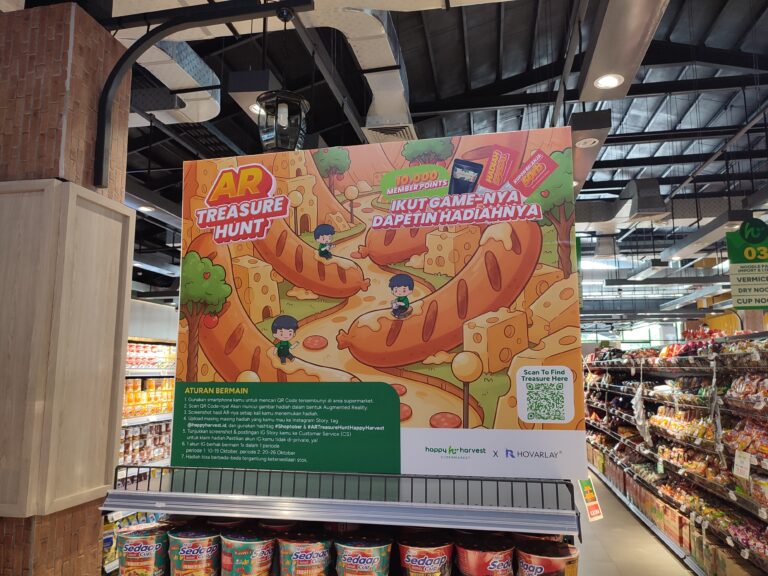
The shopper collects digital items by scanning multiple packs across a brand’s portfolio. Completing the set unlocks a larger reward. Happy Harvest Supermarket’s 10.10 Shoptober campaign used this mechanic at supermarket scale, with consumers scanning packaging across the aisles to assemble a digital collection redeemable at checkout. This is the strongest mechanic for driving multi-SKU basket lift within a portfolio.
Reveal a Story or Character
The scan triggers an unfolding narrative or character animation that plays out over multiple scans of the same or related packs. Coca-Cola Marvel scaled this with 30 Marvel characters appearing across packaging variants worldwide, each one a fresh reveal that incentivised buying different packs to complete the collection.
Skill-based Mini-games
AR-rendered mini-games on the packaging surface: a maze, a target-shoot, a reaction test, a rhythm tap. Outcomes feed into a digital leaderboard or prize pool. The mechanic earns repeat scans because the consumer wants to beat their previous score. Best fits youth-oriented categories: confectionery, snacks, energy drinks, mobile gaming-adjacent products.
Prize Structures That Earn Repeat Scans
The economic mistake in gamified AR packaging is treating the prize as a fixed cost. The prize structure is a variable that shapes the entire funnel. Three structures work in CPG environments.
Instant-win With High Frequency, Small Prize
Every scan reveals a prize: a 5 percent off coupon, a free sample at next purchase, a points credit. The economics work because most consumers redeem only a fraction of the small prizes, and the perceived win-rate keeps the mechanic engaging. The Uniqode 2026 data showed 52 percent of QR scans motivated by discounts, which validates this structure for high-volume CPG SKUs.
Tiered Prize Pool With Collection Mechanic
Each scan produces a small prize plus a collectible piece. Collecting the set unlocks a high-value reward. This structure layers immediate gratification with long-term motivation, and is the strongest model for driving repeat purchase across a portfolio.
Sweepstakes With Single Grand Prize
Every scan is an entry into a single-winner draw. Economics are simple. Engagement is broad but shallow per individual. Works best as a launch mechanic for short campaigns where buzz matters more than long-term engagement.
The Post-scan Funnel That Captures Value
The mechanic delivers the engagement. The funnel captures the value. Most gamified AR packaging underdelivers because the funnel ends at the prize reveal instead of beginning there.
Step One: The Win Moment
The reveal is the dopamine peak. This is when the consumer is most receptive to the next ask. Asking for email opt-in to claim the prize is the cleanest first-party data capture moment in the entire funnel. Uniqode’s 2026 research found over 80 percent of consumers are willing to share data through QR-triggered experiences. The reveal moment is when that willingness peaks.
Step Two: The Share Asset
After the win, offer the consumer a shareable piece of content: a branded reel of their prize win, a personalised digital token, a story-format result they can post. Social sharing extends the campaign reach without paid amplification. The mechanic only works if the share asset is genuinely shareable, not a watermarked screenshot.
Step Three: The Next Action
Once the consumer has shared, they’re ready for a contextual next action. A second scan suggestion, a related SKU recommendation, an enrolment into the brand’s loyalty programme, a recipe or usage tutorial. Whatever extends the relationship beyond the prize win. The brands that monetise gamified AR are the brands that engineer this step. The brands that don’t are running a sweepstakes with extra technical steps.
Mistakes That Kill Gamified AR Campaigns
Three failure patterns appear repeatedly in regional Southeast Asian deployments.
Prize value misalignment. A spin-to-win mechanic that reveals ‘thank you for participating’ for 80 percent of scans burns goodwill faster than no game at all. Every scan should produce a real outcome, even if the outcome is small.
Mechanic friction. A scan-to-win that takes 10 seconds to load on a 4G connection in a supermarket aisle is no longer scan-to-win. It’s scan-and-give-up. The first technical decision in any gamified campaign is mobile load speed, not 3D fidelity.
No carry-forward design. The consumer plays once, wins, and is dropped. The brand spent money on the AR but didn’t capture the relationship. Always design for the second scan, the second purchase, and the email follow-up.
What the Data Tells Brand Teams Considering Gamification
Three data points anchor the case for gamified AR packaging in 2026. Two-thirds of QR-enabled packaging programmes now include game mechanics, per Appetite Creative. The gamification and loyalty programs segment is forecast to grow at the fastest CAGR within AR packaging, per Towards Packaging. And 75 percent of consumers scan QR codes specifically to get something, per Uniqode’s 2026 analysis of nearly 800,000 codes.
The shopper expects a payoff. The category is moving toward gamification. The brands that build the mechanic into their packaging substrate now will have a measurable engagement and data-capture advantage over the brands that don’t, sustained across multiple product cycles. Static packaging will not look static for much longer.
Frequently Asked Questions
Q: How big does the prize pool need to be to justify a gamified AR campaign?
Prize pool economics depend on expected scan volume and target conversion rate. A rule of thumb for instant-win structures is that the total prize value across all scans should sit between 5 and 15 percent of the expected total campaign reach value, with most prizes being low-cost digital coupons rather than physical prizes.
Q: Does gamification work on premium and luxury packaging?
Yes, but the mechanic shifts. Premium brands lean into reveal mechanics, exclusive content unlocks, and limited-edition collectible mechanics, rather than spin-to-win. The Glenlivet Code with Zappar demonstrated this pattern: a cipher mechanic that suited the premium positioning, with the gamification embedded in the storytelling rather than overlaid on top.
Q: Can we run a gamified AR campaign in compliance with prize promotion regulations?
Yes, with normal sweepstakes and prize promotion compliance. The regulations that apply to physical sweepstakes apply equally to AR-triggered ones. The standard structure is no purchase necessary for the grand prize, full terms accessible from the experience, age verification where required, and a clearly disclosed campaign period. Regional compliance varies, so confirm with legal counsel in each market.
Q: What’s the right balance between game complexity and load speed?
Load speed wins almost every trade-off. A consumer who waited eight seconds for a complex 3D environment to load is gone. A consumer who got an engaging two-second scan into a simple mechanic stays. Optimise the 3D assets aggressively, host them on a fast CDN, and treat anything beyond 4-second load time as a campaign-killing latency.
Q: How do we prevent fraud in scan-to-win campaigns?
Standard fraud controls include unique scan tracking per session, IP and device-level abuse detection, prize claim verification through email confirmation, and per-user prize limits. For high-value prizes, a manual verification step before fulfilment is standard. The technical infrastructure to prevent fraud is mature and not a barrier to running gamified packaging at scale.
About the author
Kimming Yap is the Co-Founder of HOVARLAY, an experience technology company building AR-enabled packaging and interactive consumer experiences for CPG brands across Southeast Asia.