On this page
AR for Food and Beverage Packaging: What Brands Need to Know
- What Is AR for Food and Beverage Packaging?
- Why F&B Brands Are Adopting AR Packaging
- Shelf competition is intense
- First-party data is scarce
- Campaign activation costs are high
- What F&B Brands Can Do with AR Packaging
- Origin and ingredient storytelling
- Recipe and usage content
- Loyalty and reward campaigns
- Seasonal and limited edition activations
- Transparency and regulatory compliance
- How to Add AR to F&B Packaging
- Step 1: Build the experience with HOVARLAY Creator
- Step 2: Generate your QR code
- Step 3: Add the QR code to packaging
- Step 4: Track performance in HOVARLAY Insights
- AR for F&B Across Southeast Asia
- Frequently Asked Questions
- Does AR for food packaging require an app?
- Can AR be added to existing F&B packaging without reprinting?
- What kind of AR experience works best for food and beverage brands?
- How much does AR packaging cost for an F&B brand?
- How do F&B brands measure AR packaging performance?


- AR for food and beverage packaging turns product labels into interactive digital experiences accessible via a QR code scan — no app needed.
- F&B brands are using AR for origin storytelling, recipe content, loyalty campaigns, and gamified lead generation.
- HOVARLAY Campaigns averages a 13.23% conversion rate on gamified AR activations — well above digital marketing benchmarks.
- WebAR works on any smartphone, making it accessible to a broad user base without friction.
- Adding AR to existing F&B packaging requires only a QR code — no redesign, no reprint, no app development.
A bottle of hot sauce. A bag of coffee. A box of cereal. Every one of these products has a label — and every label is a missed opportunity to connect with the person holding it.
AR for food and beverage packaging fixes that. It turns the label into a live channel: brand stories, recipe content, loyalty campaigns, and gamified lead capture — all triggered by a single QR code scan.
What Is AR for Food and Beverage Packaging?
AR for food and beverage packaging is the use of augmented reality technology to add an interactive digital layer to F&B product packaging, accessible by scanning a QR code with any smartphone.
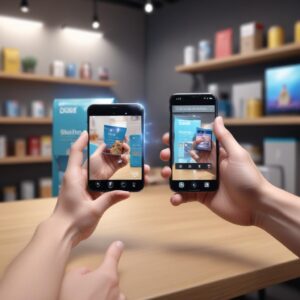
When a user scans the QR code on a product, their browser opens an AR experience. Content overlays appear on or around the product: an animated brand character, a recipe video, a spinning prize wheel, a sourcing story told through 3D visuals. The experience runs entirely in the browser — no app download, no account creation.
For F&B brands, this changes the packaging from a one-time communication to a persistent engagement platform. The label that once told you the ingredients can now tell you the story behind them, reward your loyalty, and capture your contact details for future campaigns.
Why F&B Brands Are Adopting AR Packaging
F&B brands are adopting AR packaging because it solves three problems that traditional packaging cannot: engagement depth, first-party data collection, and campaign activation without media spend.
Shelf competition is intense
In a supermarket aisle, your product has 2-3 seconds to capture attention. Static packaging design is the primary lever — but it is a finite one. AR extends that window. A user who scans and engages with a 90-second AR experience has had significantly more brand exposure than one who reads the label.
First-party data is scarce
F&B brands have historically relied on retailer data and third-party ad targeting. Both are increasingly restricted. AR packaging creates a direct data collection channel at the moment of highest brand affinity — when the user is physically holding the product. HOVARLAY Campaigns captures name, email, and phone number inside the AR experience, with 13.23% average conversion rate.
Campaign activation costs are high
Running a digital promotion typically requires paid media to drive traffic. AR packaging turns the physical product into the traffic driver. Every unit on shelf, in a shopping bag, or in a home cupboard is a potential campaign activation point. The QR code is already there — the experience is updated in the platform, not on the packaging.
What F&B Brands Can Do with AR Packaging
F&B brands are using AR packaging for origin storytelling, recipe content, loyalty campaigns, seasonal activations, and gamified lead generation — each serving a distinct commercial objective.
Origin and ingredient storytelling
Premium F&B brands — specialty coffee, craft spirits, artisan food — have rich origin stories that cannot fit on a label. AR packaging lets users scan to explore: the farm, the process, the people behind the product. Transparency builds trust. Trust drives loyalty and repeat purchase.
Recipe and usage content
Scan the sauce bottle to see recipe videos. Scan the spice pack to see how to use it. AR packaging delivers contextual content at the exact moment the user needs it — during cooking, at the supermarket, or at unboxing. This increases perceived product value and reduces the chance of a purchase being wasted.
Loyalty and reward campaigns
Scan to earn points, unlock exclusive content, or enter a prize draw. AR packaging turns every product into a loyalty touchpoint without requiring a separate loyalty app. HOVARLAY’s Campaigns product is built for exactly this: gamified lead capture inside the AR experience, with an average 13.23% conversion rate.
Seasonal and limited edition activations
CNY, Ramadan, Hari Raya, Christmas, and local festivals all create packaging activation opportunities. AR allows brands to add a seasonal experience to existing packaging without reprinting. HERA Bathroom used this approach for a CNY red packet activation — animated AR wishes triggered by scanning the packaging, with strong engagement and shareability.
Transparency and regulatory compliance
Health claims, allergen information, country-of-origin labelling, and nutritional detail are all growing in regulatory complexity. AR packaging allows brands to provide rich compliance content without cluttering the label. Users who want more information can scan. Users who don’t, won’t.
How to Add AR to F&B Packaging
Adding AR to food and beverage packaging is a four-step process: build the experience, generate a QR code, add it to packaging, and measure results.
You do not need to redesign your packaging. You do not need a developer. You do not need an app.
Step 1: Build the experience with HOVARLAY Creator
HOVARLAY Creator is a drag-and-drop no-code builder. Upload your assets — videos, 3D models, images, animations — and arrange the experience visually. Choose your interaction type: watch, play, or submit.
Step 2: Generate your QR code
HOVARLAY generates a dynamic QR code linked to your experience. Dynamic means the experience behind the QR code can be updated at any time without changing the printed code.
Step 3: Add the QR code to packaging
Print the QR code on your next production run, add it as a sticker to existing stock, or embed it in secondary packaging. No special inks or printing processes required — it is a standard print element.
Step 4: Track performance in HOVARLAY Insights
Scan volume, unique users, engagement time, interaction events, and lead capture conversions are all visible in the HOVARLAY Insights dashboard in real time.
AR for F&B Across Southeast Asia
Southeast Asia is an ideal market for AR food and beverage packaging, combining high smartphone penetration, strong QR code familiarity, and a large F&B-spending middle class.
Indonesia is HOVARLAY’s primary market — with over 270 million users, a young median age, and rapidly growing modern trade. F&B brands selling in Indomaret, Alfamart, and modern hypermarkets have an immediate opportunity to differentiate with AR packaging.
Singapore’s premium F&B market is well-suited for origin storytelling and transparency-driven AR experiences. Regional brands headquartered in Singapore can build once and deploy across multiple Southeast Asian markets.
Frequently Asked Questions
Does AR for food packaging require an app?
No. HOVARLAY uses WebAR — the experience runs in any smartphone browser. Users scan the QR code and the AR activates instantly. No download required.
Can AR be added to existing F&B packaging without reprinting?
Yes. A QR code sticker can be applied to existing packaging stock. For the next production run, the QR code is included in the label design as a standard print element.
What kind of AR experience works best for food and beverage brands?
Origin storytelling, recipe content, and gamified loyalty campaigns work particularly well for F&B. The right choice depends on your campaign objective: engagement, data capture, or education.
How much does AR packaging cost for an F&B brand?
HOVARLAY starts free. Paid plans start at $6-9 per SKU per month. See HOVARLAY pricing for full details. Adding a QR code to existing packaging has minimal print cost.
How do F&B brands measure AR packaging performance?
HOVARLAY Insights tracks scan volume, unique users, engagement time, and lead capture conversions. For campaigns, conversion rate is the primary metric — HOVARLAY averages 13.23% across activations.
Add AR to your F&B packaging today. Start free on HOVARLAY →