On this page
AR for Beverage Brands: Why Round Bottles Don’t Work and What to Use Instead


The Bottle Problem
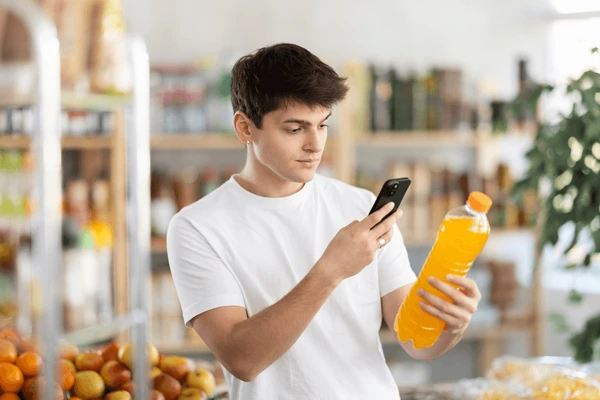
Three out of four AR beverage briefs that cross our desk open with the same question: how do we put an AR experience on the bottle. The honest answer is that you usually don’t, and any platform that says otherwise is either using a method it isn’t explaining clearly or hasn’t tested the result at retail scale.
Image-tracking AR works by matching what the camera sees against a stored visual marker. The match has to be confident enough to anchor a 3D scene to the surface and hold it there as the consumer moves their phone. Two physical realities make round glass and PET bottles a poor candidate for this:
Surface curvature. The label on a 330ml beer bottle wraps around roughly 60 to 70 percent of the circumference. From a standard scanning distance, the camera sees a curved projection of the label, not its flat printed form. The further from the centre line you look, the more the image distorts. Tracking algorithms trained on flat reference images either fail to lock or drift visibly during the experience.
Reflection. Glass and metallised PET reflect ambient light directly back into the camera, producing highlights that change with every micro-movement. Consumer-grade tracking treats those highlights as features. They aren’t stable features, so the tracker keeps re-anchoring, and the AR scene appears to jitter.
There are workarounds for both. None of them are clean. Cylindrical tracking models exist but require deeper computer vision work than most no-code platforms support. Anti-reflective coatings exist but cost more than most beverage SKUs can absorb. The pragmatic answer for beverage marketing teams is to stop trying to put AR on the bottle and start designing for the surfaces where it actually works.
Where AR for Beverages Actually Works
Beverage portfolios are richer in flat surfaces than most marketers realise. Five of them are commercially proven.
1. Secondary Packaging and Multi-Pack Outer Cartons
Multi-pack outer boxes for beer, soft drinks, RTD coffee, and energy drinks are flat-panel printable surfaces. They sit on shelf next to the primary bottles and are often more visually prominent than the individual SKU.
Coca-Cola’s 2024 collaboration with Marvel, which ran across 50 countries with 30+ Marvel characters appearing in AR when scanned, used specially designed multi-pack packaging that brought characters to life through scanned activations, demonstrating how secondary packaging carries the AR experience even when primary bottles cannot.
2. Tetra Pak and Gable-Top Cartons
RTD coffee, juices, plant milk, and increasingly RTD alcohol use Tetra Pak and gable-top cartons. These are flat-panelled, matte-finished surfaces that track cleanly. The panel size is comparable to a small poster, which gives marker designers room to create an image that doubles as both packaging design and AR trigger.
Tetra Pak’s own connected packaging programme has been pushing brand owners in this direction since 2023, citing the printability of cartons as a strategic advantage over rigid bottles.
3. Gift Sets, Limited Editions, and Seasonal Packs
Beverages convert into gifts more than most categories: whisky and wine boxes at year-end, premium spirits at Lunar New Year, festive coffee assortments, craft beer assortment crates. These secondary structures are flat, often printed on heavy stock, and carry a marketing premium that justifies the AR investment.
Pernod Ricard’s earlier work on The Glenlivet Code with Zappar, which used the limited-edition outer box as the AR trigger rather than the bottle, set the pattern for premium spirits in this category.
4. Bar and On-Trade Collateral
The on-trade channel runs on flat collateral. Drinks menus, table tents, coasters, promotional cards, branded napkins, A-frames at the bar entrance. Every one of these is a more reliable AR surface than the bottle being poured behind the counter.
A bar-side cocktail menu with a scannable trigger that reveals a 3D pour of the featured cocktail, an ingredient origin story, or a bartender video gives the consumer a longer dwell time than they would ever spend on a bottle they have already chosen to order.
5. Point-Of-Sale and Shelf Collateral
Shelf wobblers, neck-hangers, header cards, and floor decals carry AR triggers well. They are designed for shopper attention at the moment of decision. They are printed flat. They are not constrained by the SKU itself.
For beverages, this matters because point-of-sale is where the buying decision happens. Putting the interactive experience on the wobbler rather than the bottle means it triggers during consideration, not after consumption.
What The Data Says About AR for Beverage Marketing
The market context for AR-enabled packaging in beverages is robust. The food and beverages segment dominated the global AR packaging market with a 36.4 percent revenue share in 2024 according to Grand View Research’s 2025 industry report, and the segment continues to lead category investment. The wider AR in packaging market is forecast to grow from USD 375.80 million in 2025 to USD 730.64 million by 2035 at a 7.0 percent compound annual growth rate, according to InsightAce Analytic’s January 2026 estimate.
Consumer behaviour reinforces the spending case. Mindshare UK’s Layered neurological study, conducted with Zappar, found that memory encoding was 70 percent higher in AR tasks than in non-AR tasks. Snap’s 2025 research with Publicis Media and NRG reported that 72 percent of Snapchatters agree AR advertisements capture their attention more effectively than traditional ads. These numbers explain why category leaders such as Coca-Cola, Nestlé, and Mondelez are committing media weight to AR-enabled beverage activations.
What the headline numbers do not say is that this engagement only materialises when the AR experience triggers cleanly. A round-bottle AR campaign that takes three scan attempts to load delivers no memory encoding advantage. It delivers frustration. The substrate matters.
Designing an AR Beverage Campaign That Ships
If you are scoping an AR beverage activation, four design decisions will determine whether it works at retail.
Choose The Surface Before Choosing The Experience
Most briefs work the other way around. The team decides on the experience, then asks where to put the trigger. By the time the bottle is the only option left, the project is already compromised. Lead with surface selection: which printed surface in your channel mix has the highest dwell potential and the cleanest AR substrate? Build the experience around that.
Match The AR Mechanic to The Consumption Moment
Gamification fits impulse purchases. Storytelling fits premium and gifting. Provenance fits craft and heritage. Tutorial fits new-product education. A spin-to-win on a craft whisky outer box feels off-brand. A barrel-to-bottle provenance walkthrough feels right. The reverse is true for an energy drink multi-pack at convenience retail.
Pick a No-App Delivery Method
App-based AR requires the consumer to download. At the bar, with their thumb hovering over the order button, they will not. WebAR opens in the browser from a QR scan, which is the standard for in-market beverage activations and the model used by the major CPG case studies. The Uniqode State of QR Codes 2026 report, based on analysis of 188 million scans across nearly 800,000 codes, confirms that 71 percent of consumers find QR codes useful in daily life. That is the entry point that matters.
Plan for The Post-Scan Moment
The most common failure mode in AR beverage marketing is not the AR itself. It is what happens after the scan. The user lands inside the experience and there is no clear next action. No reveal mechanic, no incentive to share, no follow-on offer, no first-party data capture. Just an ambient 3D scene that ends as abruptly as it began.
Design the funnel before you commission the 3D. Decide what the scan should produce: a coupon, a UGC moment, an email opt-in, an entry to a draw, a recipe download, a cocktail-of-the-month subscription. Without that, you have spent money on a tech demo.
What This Means for The Next Beverage Campaign Brief
Beverage marketers who want AR in 2026 should brief it on the secondary packaging, not the SKU. They should write the substrate into the brief from the first line. They should commit to flat-format triggers across multi-pack outers, gift cartons, on-trade collateral, and point-of-sale, and they should design the post-scan funnel before they design the 3D.
The brands doing this consistently in Southeast Asia are not the largest spenders. They are the ones who built their AR roadmap around physical-format reality rather than aspirational mock-ups.
Frequently Asked Questions
Q : Can AR Work on Aluminum Beverage Cans?
Cans are technically round but with tighter, more uniform curvature than glass bottles, which gives some tracking algorithms a fighting chance. Performance in practice is mixed. Tracking quality depends on can size, label print finish, and lighting conditions at the point of scan. For brands that want consistent results across markets, the safer bet remains flat secondary packaging or point-of-sale.
Q : What About NFC Tags Embedded in Bottle Labels?
NFC works on any surface, including round bottles, because it doesn’t depend on visual recognition. It does require an NFC-enabled phone and a deliberate tap action from the consumer. NFC is a valid alternative for premium spirits where the brand can teach the gesture, but it is not a substitute for the scale of QR-triggered WebAR in mass beverage retail.
Q : How Much Does an AR Beverage Campaign Cost?
Cost varies widely depending on the platform, the 3D asset complexity, and the scale of deployment. Simple WebAR experiences using a no-code platform with reusable 3D templates can launch for the cost of a mid-range digital campaign. Custom-built experiences using bespoke 3D, animation, and gamification logic move into the cost range of a regional TVC. The cost driver is the experience design, not the platform license.
Q : How Do We Measure Success on an AR Beverage Campaign?
The right KPI mix depends on the campaign objective. For awareness campaigns, scan rate against impressions, social shares, and dwell time are the leading indicators. For conversion campaigns, opt-in rate, coupon redemption, and attributed retail sale add the bottom-line signal. The Uniqode 2026 research found that only 12 percent of marketers currently measure QR campaigns against revenue, which is the gap to close in any serious AR rollout.
Q : Is WebAR or App-Based AR Better for Beverages?
For beverages, almost always WebAR. The friction of an app download is incompatible with the impulse and on-trade purchase moments where beverage AR has its strongest fit. App-based AR has a place where the brand owns a high-engagement loyalty app already, but for a category-level beverage activation, WebAR via QR is the dominant model.
About the author
Kimming Yap is the Co-Founder of HOVARLAY, an experience technology company building AR-enabled packaging and interactive consumer experiences for CPG brands across Southeast Asia.