On this page
AR for Food and Beverage Packaging: A Complete Guide
- TL;DR
- AR for Food and Beverage Packaging: A Complete Guide
- How AR for Food and Beverage Packaging Works
- What AR Delivers for Food and Beverage Brands
- AR for Food and Beverage Packaging in Practice: Key Use Cases
- How to Launch AR for Food and Beverage Packaging
- Why No-App AR Is Specifically Right for Food and Beverage
- Frequently Asked Questions


TL;DR
- AR for food and beverage packaging lets brands activate product labels with interactive experiences, directly from a phone camera, no app required.
- F&B brands use AR on packaging to deliver recipe videos, provenance stories, loyalty games, and nutritional information in seconds.
- WebAR works through a QR code scan, so there is zero friction for users and zero development overhead for brands.
- Gamified AR campaigns on F&B packaging generate an average 13.23% conversion rate, outperforming most digital ad formats (HOVARLAY internal data, 2025).
- HOVARLAY Creator lets food and beverage brands build and launch AR packaging experiences without writing a single line of code.
AR for Food and Beverage Packaging: A Complete Guide
AR for food and beverage packaging is the practice of attaching a digital experience to a physical product label, activated by scanning a QR code or pointing a phone camera at the pack. When a user scans the packaging, they see videos, animations, games, or data overlaid on or around the product, without downloading an app. For F&B brands, this turns every unit shipped into a live marketing channel.
The food and beverage packaging market is one of the largest and fastest-moving in the world. Mordor Intelligence reports that demand for packaging innovation, particularly in Asia-Pacific, is accelerating as brands compete for shelf presence and repeat purchase in crowded categories (Mordor Intelligence, 2025). AR is not a novelty in this context. It is a measurable tool for driving the actions that matter: scan, engage, convert, rebuy.
This guide covers how AR for food and beverage packaging works, what it delivers commercially, and how brands can launch a first campaign without a development team.
How AR for Food and Beverage Packaging Works
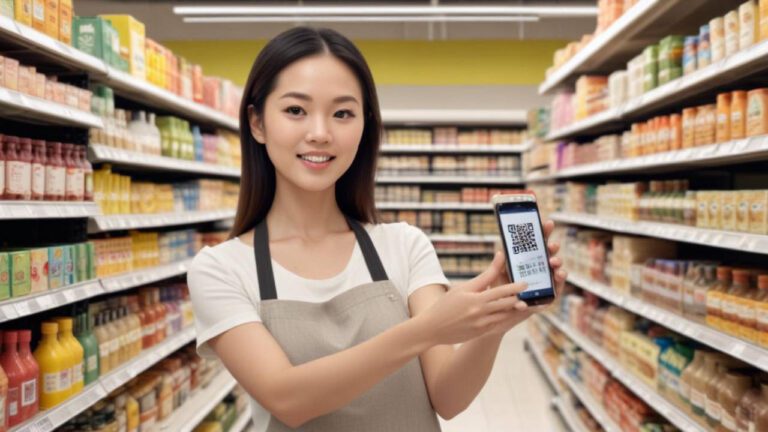
AR for food and beverage packaging works by linking a physical trigger on the pack, usually a QR code or image marker, to a WebAR experience that loads in the phone’s browser. The user scans the QR code. The browser opens instantly. No app required, no download prompt, no friction.
The experience itself can be almost anything: a 3D product animation floating above the pack, a video of the sourcing farm, a recipe finder, or a gamified loyalty mechanic. The brand builds the experience once and the QR code on the packaging does the rest for the full production run.
What makes WebAR particularly effective for F&B is the scan context. Users scan F&B packaging at home, at the supermarket, in a cafe. They already have their phone in hand. The barrier to engagement is as low as it gets in any digital channel. HOVARLAY’s Lens technology delivers the AR experience in under two seconds from scan, which keeps drop-off rates minimal.
Brands can also build multiple experiences into a single pack across a campaign calendar. A CNY limited edition run might trigger a red packet animation in January and a recipe video in February, without reprinting a single label. The QR code is permanent. The experience behind it can change at any time from the HOVARLAY dashboard.
What AR Delivers for Food and Beverage Brands
AR for food and beverage packaging delivers four categories of commercial value: engagement, education, loyalty, and data.
On engagement: users who scan F&B AR packaging spend significantly more time with the brand than users who see a standard banner or shelf display. An interactive experience, whether a recipe builder, an origin story, or a gamified prize wheel, creates active attention rather than passive exposure. HOVARLAY’s Campaigns product generates an average 13.23% conversion rate across gamified AR activations, which compares strongly to industry benchmarks for in-store digital touchpoints (HOVARLAY internal data, 2025).
On education: F&B packaging has always been the brand’s primary communication surface. AR extends that surface into motion and interactivity. Ingredient stories, allergen breakdowns, preparation guides, and sustainability claims all land harder as a 60-second experience than as back-of-pack copy. Brands in the health food and premium beverage segments have used this to differentiate at shelf without changing their physical design.
On loyalty: gamified AR mechanics on F&B packaging can drive repeat purchase directly. A scratch card experience, a stamp collection game, or a prize draw accessed by scanning each pack creates a reason to buy again that lives on the packaging itself. The Happy Harvest 10.10 campaign, built on HOVARLAY’s platform, used gamified AR on packaging to drive repeat scan behaviour across a promotional window. On data: every scan is a trackable event. HOVARLAY Insights captures scan volume, engagement time, CTA clicks, and lead capture completions. F&B brands gain first-party data from the packaging channel, a channel that previously generated zero digital signal.
AR for Food and Beverage Packaging in Practice: Key Use Cases
The most effective use cases for AR on F&B packaging fall into five categories, each with a different primary goal.
Recipe and occasion content is the most common entry point. A sauce brand links the QR code on the bottle to a short video recipe. A snack brand shows a serving suggestion for the relevant meal occasion. The experience refreshes seasonally. Users who engage are more likely to repurchase because the brand has delivered utility at the exact moment of consumption.
Provenance and sustainability storytelling is growing fast in premium categories. A coffee brand shows the farm and the farmer. A craft spirits brand maps the distillery journey. A plant-based food brand explains the supply chain in 90 seconds. These experiences build the trust that justifies a price premium, and they are measurable: HOVARLAY Insights shows how long users spent on each scene.
Gamified promotions are the highest-conversion use case. A spin wheel, a lucky draw, or a seasonal prize mechanic accessed by scanning the pack drives both engagement and lead capture. The 13.23% average conversion rate across HOVARLAY’s gamified campaigns reflects how well this format performs when the trigger is physical packaging (HOVARLAY internal data, 2025).
Nutritional and regulatory information is an emerging use case in regulated F&B categories. Brands use AR to present extended nutritional data, allergen information, and certification details without crowding the physical label. In markets where labelling requirements are tightening, this approach provides compliance headroom without a packaging redesign.
Limited edition and collector activations work particularly well for F&B brands with seasonal or special edition SKUs. A collector’s range triggers a unique animation per variant. Users scan to reveal the full set. Social sharing follows naturally. The Summarecon Golden Expo activation, which used HOVARLAY WebAR to drive engagement at a brand event, demonstrates how AR creates moments worth capturing and sharing organically.
To explore what an AR packaging experience looks like for your specific SKU, see HOVARLAY’s case studies at https://hovarlay.com/case-studies/.
How to Launch AR for Food and Beverage Packaging
Launching AR on food and beverage packaging does not require a development team, a custom app, or a six-figure budget.
The process on HOVARLAY Creator works in four steps. First, the brand defines the experience: what should users see when they scan? A video, a game, a 3D animation, a lead form? Second, the experience is built in Creator using a drag-and-drop interface. No code is required. A brand manager can build a functional WebAR experience in a working session. Third, a QR code is generated from the HOVARLAY platform. This code goes onto the artwork file for the next print run, or onto a sticker for existing stock. Fourth, the campaign goes live. Every scan after that point is tracked in HOVARLAY Insights.
The augmented reality market is projected to reach $72.7 billion by 2030 at a CAGR of 26.7% (MarketsandMarkets, 2025). F&B brands that begin piloting AR on packaging now will have established user behaviour patterns and first-party data infrastructure before AR becomes a standard category expectation.
Pricing starts at $6-9 per SKU per month on the Starter plan, which makes a first AR packaging pilot accessible for brands at any stage. There is no per-view fee and no agency required. See full pricing at https://hovarlay.com/pricing/.
For brands ready to build without a developer, HOVARLAY’s no-code AR builder is the fastest path from concept to live experience. Visit https://hovarlay.com/webar-builder/ to see how it works.
Why No-App AR Is Specifically Right for Food and Beverage
No-app AR is the correct format for food and beverage packaging because the scan moment is spontaneous, not planned.
When a user picks up a bottle of hot sauce at the supermarket or opens a cereal box at home, they are not in a mindset to download software. If activating the packaging experience requires an app install, most users will not complete it. The drop-off at the app store step is enough to make app-based AR commercially ineffective for F&B packaging at scale.
WebAR removes that friction entirely. The scan goes to a browser experience that loads in the same time it takes to unlock a phone. The user stays in the moment. Engagement happens because the path is clear and immediate. HOVARLAY’s platform is built on this principle: every experience is browser-native, QR-activated, and optimised for a single scan-to-engage flow.
This is also why HOVARLAY’s approach differs from developer-focused AR platforms. A no-code tool built for marketers, not engineers, means F&B brand teams can own the AR channel themselves. Campaigns can launch, refresh, and retire on the brand’s schedule, not on a developer’s ticket queue.
The shift is already visible in the market. Brands that piloted AR on F&B packaging in 2024 are now scaling across SKU ranges in 2025 and 2026. The question for most brand managers is no longer whether to test AR on packaging. It is which SKU to start with and what experience will perform best for that product’s occasion.
Start free at https://dashboard.hovarlay.com/signup
Frequently Asked Questions
Q: What is AR for food and beverage packaging?
AR for food and beverage packaging is the use of augmented reality technology to activate a physical product label with a digital experience. Users scan a QR code on the pack and their phone browser opens an interactive experience, such as a video, a game, or a 3D animation, with no app required. The experience overlays or accompanies the physical product in real time.
Q: Do users need to download an app to use AR on food packaging?
No. HOVARLAY uses WebAR, which means all experiences run in the phone’s browser. The user scans the QR code on the packaging and the experience loads immediately. There is no app store visit, no download, and no account creation required.
Q: What kinds of experiences can brands create with AR for food and beverage packaging?
Brands can create recipe content, provenance and origin stories, gamified loyalty mechanics such as spin wheels or lucky draws, extended nutritional information, limited edition collector experiences, and seasonal promotional activations. Each experience is built once and can be updated at any time without reprinting the packaging.
Q: How do brands measure the performance of AR packaging campaigns?
HOVARLAY Insights tracks every scan event, including scan volume by date, average engagement time, CTA click rates, and lead capture completions. This gives F&B brands first-party data from the packaging channel, which was previously a zero-signal environment. Campaign conversion rates can be tracked directly against the AR touchpoint.
Q: How much does AR for food and beverage packaging cost?
HOVARLAY’s Starter plan begins at $6-9 per SKU per month. There are no per-view fees and no agency costs required, since the platform is no-code and designed for brand teams to operate independently. Enterprise pricing is available for brands running large SKU portfolios or regional rollouts. Full details are at https://hovarlay.com/pricing/.
Related reading: AR Packaging in Indonesia | AR Packaging Examples: 10 Brands Getting It Right in 2026