On this page
Supermarket Brand Days Go Phygital: An AR Shopper Marketing Playbook
- Why Supermarket Activations are AR's Strongest Retail Moment
- What A Coordinated AR Brand Day Looks Like
- A Real Southeast Asian Phygital Activation
- Designing The Activation: What to Brief, What to Skip
- Measurement: What to Track on an AR Shopper Marketing Campaign
- What to do Next if You Run Shopper Marketing for A CPG Brand
- Frequently Asked Questions


Quick Answer
AR shopper marketing turns supermarket brand days, end-cap displays, and shelf collateral into measurable interactive experiences. The format that works best in modern Southeast Asian retail is a coordinated activation across multi-pack outer boxes, shelf wobblers, A-frames, and aisle markers, all carrying the same AR trigger and feeding into one campaign analytics view. The KPI that matters most is not scan count but scan-to-action conversion in the post-scan funnel.
Why Supermarket Activations are AR’s Strongest Retail Moment
Modern supermarkets in Southeast Asia have already absorbed the digital infrastructure that AR shopper marketing relies on. Cross-border QR payment interoperability now operates in 8 of the 10 ASEAN markets, according to the Google, Temasek and Bain e-Conomy SEA 2025 report. Sixty percent of all SEA payments are digital. The consumer who scans a payment QR at checkout is the same consumer the brand is asking to scan a packaging QR in the aisle. The behaviour is already encoded.
What is missing in most supermarket activations is not consumer readiness. It is coordinated execution. A scan on the multi-pack outer that lands on a generic brand site, when 30 seconds later a shelf wobbler invites the same scan and lands on a different experience, fragments attention rather than capturing it. Coordinated phygital activations solve this. The shopper marketing brief should specify one AR trigger, one campaign destination, and a coherent funnel from aisle entry to checkout.
What A Coordinated AR Brand Day Looks Like
An AR-enabled supermarket brand day has four layers, each carrying the same trigger and reinforcing the same campaign idea.
Layer One: Aisle Entry
An A-frame or floor decal at the head of the aisle introduces the activation and gives the shopper a reason to scan. The mechanic at this stage is curiosity-driven. A countdown to a reveal, a promise of a prize, a teaser for an interactive experience further down the aisle. The trigger should be designed for distance scanning, with the QR sized to scan reliably from 1.5 to 2 metres away.
Layer Two: Shelf Interaction
Shelf wobblers, neck-hangers, and shelf-edge talkers carry the second-stage trigger. By now the shopper has committed to the aisle. The mechanic here is value-driven: a digital coupon, a personalised recipe based on what’s in the basket, a comparison tool that explains the SKU difference between sibling products on shelf. The Uniqode 2026 research confirms that 52 percent of QR scans are motivated by discounts, which makes shelf-edge offers the natural fit.
Layer Three: Packaging Activation
The multi-pack outer or primary packaging carries the third trigger. By now the shopper is holding the product. The mechanic here is consumption-led: a 3D preview of the in-pack contents, an unboxing reveal, a usage tutorial, a behind-the-scenes story. This is the moment that maps onto the actual purchase decision, and the AR mechanic should support that decision rather than distract from it.
Layer Four: Checkout and Beyond
Receipt-printed QR codes, shopping bag stickers, and email follow-up after a digital loyalty scan extend the experience past the store exit. This is where first-party data capture closes the loop. The shopper who scanned three times across the aisle is more likely to opt in at this stage than a cold visitor on the brand site.
A Real Southeast Asian Phygital Activation
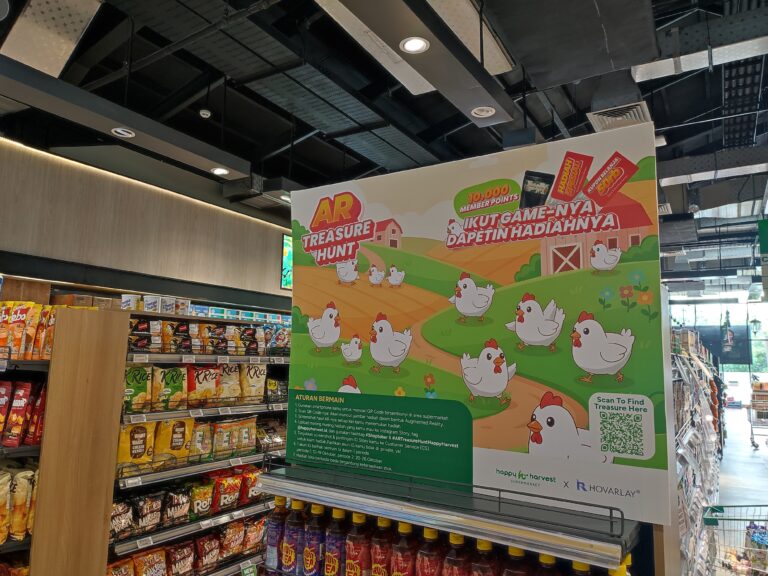
Happy Harvest Supermarket’s 10.10 Shoptober campaign in Indonesia invited shoppers into an AR treasure hunt powered by HOVARLAY. In-store campaign materials became entry points for digital discovery and participation. Explore the Happy Harvest project to see how the experience came together.
The same model is now being adopted across other regional retail formats. Indonesia Game Expo 2025 hosted a similar gamified AR brand activation by Gentong Ice Cream that bridged event retail and supermarket-style sampling moments. Summarecon Golden Expo 2025 saw multiple CPG brands run AR-driven brand activations using flat-format collateral at scale, turning event retail into a phygital playbook.
Designing The Activation: What to Brief, What to Skip
Brand teams new to AR shopper marketing often over-brief the technology and under-brief the consumer journey. The technology decisions are commodity. The journey decisions are not.
Brief: The Entry Point and The Exit Point
Where does the shopper first encounter the campaign? Where do they end up after the final scan? These two points define the funnel. Everything in between is execution. If the entry point is the aisle entry A-frame and the exit point is an email opt-in for a recipe series, you have a clear funnel that the creative can be built around. If you don’t know either point, no amount of AR creativity will rescue the campaign.
Brief: The One Trigger, The One URL
Multiple QR codes pointing to different URLs across the same activation fragment the analytics and confuse the consumer. The discipline is one campaign URL with dynamic content layers, one printed QR design (variations in size only), and one consistent visual call-to-action.
Brief: The Post-Scan Landing
The landing experience matters more than the scan. A WebAR scene that loads in eight seconds and immediately asks the consumer to enter their email will not perform. A WebAR scene that loads in two seconds, shows a 10-second engaging interaction, and then earns the right to ask for the email will. Mobile load speed is the single largest driver of post-scan abandonment.
Don’t Brief: The Technical Platform Choice
The technical platform choice is a decision for the AR partner, not for the brand marketing team. Brief the experience and the constraints (no-app, fast load, works on Android 8 and above, fits multi-pack outer print substrate). Let the AR vendor select the platform stack that meets those constraints.
Measurement: What to Track on an AR Shopper Marketing Campaign
The Uniqode 2026 research finding that 56 percent of marketers expect QR codes to drive revenue but only 12 percent measure revenue impact is a measurement gap, not a technology gap. The metrics that matter on a supermarket AR activation are not different from the metrics that matter on any other shopper marketing campaign. They just need to be wired up before the campaign runs.
Scan rate measured against printed impressions tells you whether the call-to-action and placement worked. Time-in-experience measured per session tells you whether the post-scan funnel held attention. Conversion to action, measured as coupon redemption, opt-in capture, or follow-on transaction, tells you whether the activation paid back.
The shopper marketing dashboards that already track footfall, basket conversion, and SKU-level uplift can absorb the AR campaign signal cleanly. The technical work is to pass the scan-to-action data from the WebAR platform into the CRM or shopper marketing analytics layer in real time. Done once, the same plumbing supports every subsequent AR campaign.
What to do Next if You Run Shopper Marketing for A CPG Brand
Three steps separate intent from execution. First, audit your next planned brand day or shopper marketing activation and identify every printed surface that could carry an AR trigger. Most teams find more flat-format opportunities than they expected. Second, pick one campaign objective that the AR layer should deliver on, not five. Coupon redemption, first-party data capture, social sharing, recipe download, loyalty enrolment, pick one and design the funnel for it. Third, brief a partner that can produce the WebAR experience and connect the analytics into your shopper marketing reporting before the activation ships, not after.
Phygital is no longer the experimental edge of shopper marketing. In Southeast Asia, where 60 percent of payments are already digital and QR scanning is encoded behaviour, it is the natural extension of the channel. The brands that build the playbook in 2026 will outpace the ones still running 2019-vintage shopper marketing through 2027.
Frequently Asked Questions
Q: How Does AR Shopper Marketing Differ From in-store Digital Signage?
Digital signage is broadcast. AR shopper marketing is one-to-one and interactive. Signage delivers a message to anyone in the aisle. AR delivers a personalised experience to the individual who chose to scan, on their own device, on their own timing. The data capture and the engagement depth are categorically different.
Q: Do Supermarkets in SEA Charge Brands for Running AR Activations on Their Shelves?
Most major supermarket chains treat AR shopper marketing as part of the broader retailer media network and price it accordingly. The activation may be bundled into a brand day fee, an end-cap fee, or a co-funded retailer media programme. The economics work in the brand’s favour because AR adds measurable engagement data to spend the brand was already committing to.
Q: What’s The Right Campaign Duration for an AR Brand Day?
Single-day brand activations work for high-attention moments like product launches and seasonal kickoffs. Longer multi-week activations work better when the AR content rotates dynamically across the period. The Coca-Cola Marvel campaign ran for months across 50 countries with rotating regional content behind the same printed codes, which is the model to study for portfolio-scale rollouts.
Q: Can smaller brands compete with the Coca-Colas of the World in AR Shopper Marketing?
Yes, and the smaller scale is often an advantage. The cost of a no-code AR deployment is a fraction of the cost of the print run it sits on. A regional snack brand running a single-market activation can produce a more focused, locally relevant AR experience than a global brand running 50 markets through the same template. The KPI that matters at any scale is the depth of the consumer engagement, not the breadth of the spend.
Q: What’s The Role of NFC Versus QR In Supermarket AR Activations?
QR codes scale better in supermarket environments because the consumer doesn’t need to tap. They scan from a distance, often before they pick up the product. NFC has a stronger fit in premium and luxury retail where the gesture itself is part of the experience. For mass supermarket activations in SEA, QR remains the dominant trigger and NFC is a complementary layer for premium SKUs.
About the author
Kimming Yap is the Co-Founder of HOVARLAY, an experience technology company building AR-enabled packaging and interactive consumer experiences for CPG brands across Southeast Asia.