On this page
Augmented Reality Packaging: A Guide for CPG Brands in 2026


TL;DR
- Augmented reality packaging converts a product’s physical surface into a live digital experience, triggered by scanning a QR code or image marker with a phone camera.
- Brands in FMCG, beauty, food and beverage, and luxury goods are using AR packaging to drive engagement, collect first-party data, and run in-store campaigns without reprinting a single label.
- No app is required. WebAR experiences run directly in the mobile browser, removing the biggest barrier to consumer adoption.
- HOVARLAY’s Campaigns module delivers an average conversion rate of 13.23%, meaning more than 1 in 8 scans results in a measurable brand action (HOVARLAY internal data, 2025).
- The global augmented reality market is projected to reach USD 1,050.56 billion by 2033, growing at a CAGR of 29.7% (Grand View Research, 2026), with packaging among the fastest-growing retail applications.
What Is Augmented Reality Packaging?
Augmented reality packaging is a product packaging format that links physical labels or QR codes to browser-based AR experiences, playable on any smartphone without a downloaded app.
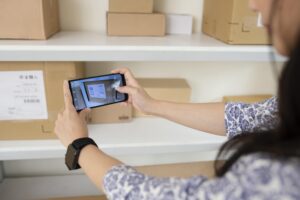
When a user points their camera at a package and scans a trigger — typically a QR code, image, or marker — a WebAR experience launches inside the browser. That experience can be a 3D product demo, a gamified coupon mechanic, a brand storytelling sequence, a virtual try-on, or a direct lead capture form. The physical product becomes an entry point into a digital layer.
The technology behind this is WebAR: augmented reality delivered over the web rather than through a native app. Because there is no download, the friction point that killed earlier generations of AR packaging is gone. Scan rates are higher. Completion rates are higher. The barrier between packaging and digital engagement collapses.
This matters for CPG brands because their packaging is already in the hands of buyers. AR does not require an additional media spend to place content in front of a target audience. The surface area is already paid for.

HOVARLAY’s platform is built specifically for this use case, giving brand teams a no-code environment to build, publish, and measure augmented reality packaging campaigns on their existing SKUs. Explore how it works at /webar-builder/.
How Augmented Reality Packaging Works
Augmented reality packaging works by embedding a scan trigger on the physical label, then linking that trigger to a hosted WebAR experience that loads directly in the user’s mobile browser.
The workflow is straightforward. A brand creates an AR experience using a no-code builder like HOVARLAY Creator. The experience is published to a hosted URL. A QR code or image marker pointing to that URL is printed on or applied to the packaging. When a user scans it, the browser opens the AR experience without any app installation.
From a technical standpoint, the AR layer is rendered using browser-native WebGL and WebXR capabilities. HOVARLAY’s Lens product handles the viewer, while HOVARLAY Creator handles the content creation. The experience can include 3D objects, animations, video overlays, gamification modules, and embedded forms.
On the analytics side, HOVARLAY Insights tracks every scan event, session duration, interaction depth, and lead capture outcome. Brand teams see exactly which SKUs are performing and what actions users are taking inside the experience. This converts packaging from a broadcast medium into a two-way data channel.
For brands managing multiple SKUs across different markets, HOVARLAY’s per-SKU pricing model means each product gets its own experience and analytics, with costs that scale predictably. Review the pricing structure at /pricing/.
Why CPG Brands Are Piloting Augmented Reality Packaging Now
CPG brands are beginning to test augmented reality packaging because the economics have shifted: the cost to build and host a WebAR experience has dropped significantly, and the payoff in first-party data and campaign conversion has become measurable.
Three structural factors are driving this shift. First, the global AR market is growing fast. Grand View Research forecasts it reaching USD 1,050.56 billion by 2033 at a 29.7% CAGR (Grand View Research, 2026), with retail and packaging among the primary growth segments. Brands that establish AR packaging capabilities now build a compound advantage over those that wait.
Second, first-party data collection is under increasing pressure. With third-party cookies phased out across major browsers and platforms, packaging-triggered AR campaigns represent one of the few channels where brands can capture first-party email, phone, and preference data directly from a product scan. HOVARLAY’s Campaigns module generated a 13.23% campaign conversion rate across its deployed activations, meaning brands collect real contact data at meaningful scale (HOVARLAY internal data, 2025).
Third, AR packaging does not require reprinting labels. A brand can update the digital experience behind an existing QR code without touching physical inventory. Seasonal promotions, limited-edition content, new campaign mechanics — all deployable without new packaging runs. This makes AR packaging operationally flexible in a way that traditional label changes are not.
Happy Harvest piloted AR packaging through HOVARLAY for their 10.10 campaign, deploying a gamified experience that ran directly from product packaging with no app and no reprint. The campaign ran on schedule without a development team.
Augmented Reality Packaging for Different Industry Verticals
Augmented reality packaging applies differently across product categories, but the underlying value is consistent: more information, more engagement, and a direct data channel from physical product to brand.
In food and beverage, AR packaging is used to share origin stories, recipe content, nutritional context, and seasonal promotions. A beverage brand can link a scan to a cocktail recipe with a spin-to-win mechanic attached. The packaging becomes a content hub that changes with each campaign cycle. HOVARLAY’s Creator supports these use cases without requiring a developer on the brand team.
In beauty and personal care, AR packaging enables virtual try-on experiences directly from the product. A user scans a foundation or lipstick box and sees the shade applied in real time through the camera. For brands in Singapore and Southeast Asia, where physical retail shelves are competitive and space is expensive, AR packaging creates a product experience layer that shelves cannot. See how augmented reality packaging works in this space at /case-studies/.
In luxury and collectibles, AR packaging adds authentication value and storytelling depth. A limited-edition product with an AR layer becomes a collectible interaction, not just a physical object. HOVARLAY’s HERA Bathroom AR activation for CNY red packets is an example of this: packaging that would otherwise be discarded became a preserved digital experience tied to the brand.
Across all verticals, the shared outcome is the same. Augmented reality packaging turns a one-time physical interaction into a repeatable digital one.
How to Start Your First Augmented Reality Packaging Campaign
Getting started with augmented reality packaging does not require a large budget or a development team. The fastest path from zero to live is a one-SKU pilot.
Start with a single product. Choose a SKU with an existing QR code on the label, or plan to add one at the next print run. The QR code points to the HOVARLAY-hosted experience URL, which you configure inside Creator. The entire setup, from blank canvas to published experience, is achievable in a single session for a team without AR or coding experience.
Define your campaign objective before building. Augmented reality packaging can serve different goals: brand storytelling, lead capture, promotional redemption, loyalty program entry, or product education. HOVARLAY’s Campaigns module is designed for gamified lead gen, while Lens handles pure brand experience delivery. Choosing the right module before you build prevents rework.
Run the pilot for a defined window, typically four to eight weeks. Use HOVARLAY Insights to track scan volume, session depth, and conversion rate against your chosen objective. At the end of the pilot, you have real data: how many people scanned, how many completed the experience, and how many converted into a measurable brand action.
From there, scaling to additional SKUs is an operational decision, not a technical one. Each new SKU gets its own experience, its own QR code, and its own analytics stream inside the same HOVARLAY account.
FAQ
What is augmented reality packaging?
Augmented reality packaging links physical product labels or QR codes to browser-based AR experiences that play directly on a mobile phone. Users scan the packaging, and a digital layer — animations, 3D objects, gamification, or video — appears in their camera view without a downloaded app.
Does augmented reality packaging require users to download an app?
No. HOVARLAY’s AR experiences run in the mobile browser using WebAR technology. There is no app download required, which removes the main adoption barrier and increases scan completion rates compared to app-dependent AR formats.
How do brands measure the performance of augmented reality packaging?
HOVARLAY Insights tracks every scan event, session length, interaction depth, and conversion outcome in real time. Brands can see which SKUs are generating engagement, what actions users take inside the experience, and how many scans result in a measurable brand action such as a lead capture or coupon redemption.
How much does it cost to build an augmented reality packaging campaign?
HOVARLAY’s pricing is per-SKU, starting with a free tier and scaling through Starter (USD 6-9/SKU/month), Pro (USD 39-59/SKU/month), and Enterprise plans. Brands can pilot augmented reality packaging on one SKU for free before committing to broader deployment. See full pricing at /pricing/.
What types of experiences can be built with augmented reality packaging?
HOVARLAY supports 3D product visualisations, brand story overlays, gamified spin-to-win mechanics, virtual try-on, lead capture forms, and video sequences. The no-code Creator tool allows brand teams to build and update these experiences without developer involvement, and new campaign content can be deployed over an existing QR code without reprinting packaging.
Related reading: AR Packaging Solution: How to Select the Right One | How AR Packaging Works: From QR Code to Immersive Experience