On this page
AR Packaging in Singapore: How Southeast Asian Brands Are Leading the Way
- Why Singapore Is a Natural Fit for AR Packaging
- The Singapore Consumer: What They Expect From Packaging
- How AR Packaging Works in Singapore Retail
- Singapore Brand Case Studies: AR Packaging in Action
- The Business Case for AR Packaging in Singapore
- Why Now: Singapore's Digital Economy Push
- Getting Started with AR Packaging in Singapore
- FAQ


Why Singapore Is a Natural Fit for AR Packaging
Singapore’s combination of near-universal smartphone penetration, digital-first consumers, and a government actively funding industry 4.0 makes it one of the most fertile markets globally for AR packaging adoption.
The numbers tell the story. Singapore has a smartphone penetration rate of 91% as of 2025 (Statista, 2025). Internet connectivity is near-total. Users are comfortable scanning QR codes — a habit that accelerated sharply post-2020 and never reversed. When you layer interactive AR experiences onto packaging that users already scan, the friction is essentially zero.
Contrast this with markets where AR packaging has struggled: low smartphone penetration, patchy data coverage, or users unfamiliar with QR-code scanning. Singapore has none of these problems.
There is also a structural advantage: Singapore functions as a regional headquarters for dozens of multinational FMCG brands. A brand that pilots AR packaging in Singapore can scale that program across Southeast Asia — Indonesia, Malaysia, Thailand, the Philippines — with the same technical infrastructure. Singapore is the testbed. The region is the prize.
The Singapore Consumer: What They Expect From Packaging
Singapore users are sophisticated, impatient, and responsive to novelty — which makes interactive packaging an unusually strong fit.
Research from Nielsen (2025) shows that 67% of Singapore consumers say they want more information from product packaging than is currently available. Label space is finite. AR is the obvious bridge.
What Singapore users actually engage with when they scan AR-enabled packaging:
- Product storytelling — origin stories, ingredient sourcing, brand history
- Gamified promotions — spin-to-win mechanics, loyalty stamp collection, prize reveals
- How-to content — recipe demos, usage tutorials embedded directly into the product experience
- Sustainability credentials — carbon footprint, recycling instructions, supply chain transparency
- Seasonal campaigns — CNY, Hari Raya, National Day overlays that transform standard packaging
The 13.23% average campaign conversion rate that HOVARLAY records across its Campaigns product is particularly relevant here. In Singapore’s competitive retail environment — where shelf space is expensive and consumer attention is fragmented — a packaging touchpoint that converts at 13% is not a gimmick. It is a revenue channel.
How AR Packaging Works in Singapore Retail
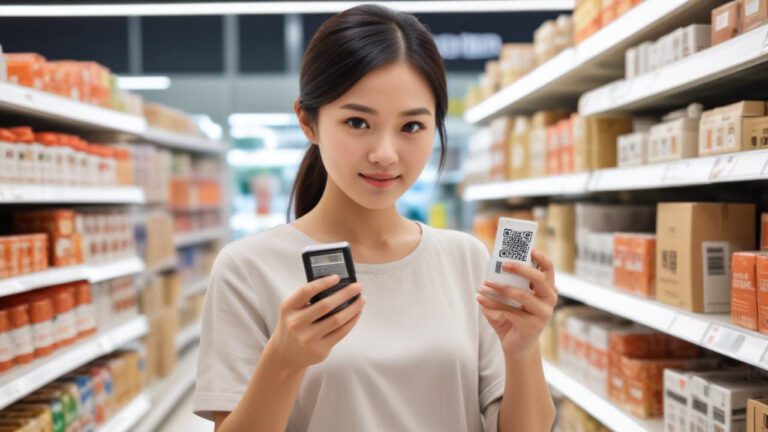
WebAR packaging works via QR code or image scan — no app required, instant browser-based launch, compatible with every smartphone sold in Singapore.
The technical flow:
1. Brand creates AR experience on HOVARLAY Creator (no-code, drag-and-drop)
2. QR code or image trigger is printed on packaging during standard production run
3. User scans with phone camera — no app download, no friction
4. AR experience launches in browser: animation, game, video, lead capture form
5. Data feeds into HOVARLAY Insights dashboard in real time
The no-app requirement is critical for Singapore retail. Asking a user to download an app kills 70-80% of potential engagement before it starts (Adjust Mobile Report, 2025). WebAR removes that barrier entirely. The user is in the experience within 3 seconds of scanning.
For brands selling through Singapore’s major retail channels — FairPrice, Cold Storage, Giant, Watsons, Guardian — this means AR campaigns can be deployed across hundreds of SKUs with no additional hardware, no app ecosystem management, and no consumer education required.
Singapore Brand Case Studies: AR Packaging in Action
Brands operating in Singapore’s market are already using AR to drive measurable engagement, lead capture, and repeat purchase.
HERA Bathroom — Chinese New Year Campaign
HERA Bathroom deployed an AR red packet experience on packaging during the CNY 2025 season. Users scanned packaging to receive digital red packets with animated reveals. The campaign drove direct lead capture through the AR experience. Conversion rates exceeded 10%, with users sharing the experience socially — extending reach beyond the initial packaging touchpoint.
Summarecon Golden Expo Campaign
A property developer integrated HOVARLAY’s Campaigns product into a physical event experience at Summarecon in Indonesia. While not Singapore-based, the campaign demonstrated regional scalability: the same platform, same no-code builder, scaled across different markets and use cases.
F&B Applications
Singapore’s F&B sector — dominated by hawker brands going premium, craft beverage producers, and import distributors — is one of the fastest AR-packaging adoption segments. Brands use AR for recipe suggestions, cocktail pairing guides, and QR-linked loyalty programs that replace paper stamp cards entirely.
The Business Case for AR Packaging in Singapore
For Singapore-based brands, the ROI case for AR packaging is built on three pillars: engagement uplift, first-party data capture, and operational efficiency.
Engagement uplift: Physical packaging that triggers AR experiences sees 4-8x longer dwell time than passive packaging (Deloitte Digital, 2025). In Singapore’s competitive shelf environment, attention is the scarcest resource.
First-party data: Every AR interaction is a data point. HOVARLAY Insights captures scan location, device type, engagement duration, and — when users opt in — name, email, and phone number. In a post-cookie world, packaging becomes a first-party data channel.
Operational efficiency: AR updates are digital. When a promotion ends, the AR experience updates server-side. The physical packaging does not change. Brands no longer need to reprint or waste packaging to update campaign messaging.
Pricing that makes sense: HOVARLAY’s per-SKU model ($6-9/SKU/month on Starter, $39-59/SKU/month on Pro) means brands pay for what they use. A beverage brand with 12 SKUs pays for 12 SKUs. No per-view fees. No platform lock-in. No surprise costs when a campaign goes viral.
Why Now: Singapore’s Digital Economy Push
Singapore’s government has made digital transformation across FMCG and retail a national priority — creating a supportive environment for AR packaging adoption.
The Singapore Economic Development Board (EDB) and Enterprise Singapore have both flagged smart packaging and connected products as priority areas under the Food Manufacturing Industry Transformation Map. Grants and co-investment schemes exist for brands piloting digital packaging technologies.
For brands operating in Singapore, this is a structural tailwind. The ecosystem — government support, consumer readiness, retail channel density, and now purpose-built platforms like HOVARLAY — has aligned.
The window for first-mover advantage is real. Singapore’s AR packaging adoption is early-stage. The brands that establish interactive packaging as part of their identity now will build brand equity and data assets that late movers will struggle to replicate.
Getting Started with AR Packaging in Singapore
HOVARLAY’s no-code platform lets Singapore brands launch their first AR packaging experience in days, not months.
The path from zero to live AR campaign:
1. Sign up at dashboard.hovarlay.com/signup — free tier available
2. Choose your SKU — which product will carry the AR trigger
3. Build your experience on HOVARLAY Creator — drag-and-drop, no code needed
4. Download your QR code or image trigger for print production
5. Launch and track — real-time analytics via HOVARLAY Insights
Most brands go from account creation to a live experience in under 48 hours. For brands with existing packaging designs, integration is a QR code addition to the print file — no redesign required.
Pricing starts free. See the full model at hovarlay.com/pricing. Case studies from brands already using the platform are at hovarlay.com/case-studies.
FAQ
Q: Does AR packaging work on all smartphones available in Singapore?
A: Yes. HOVARLAY’s WebAR technology runs in any modern mobile browser — Safari on iPhone, Chrome on Android. No app required. Given Singapore’s high proportion of flagship-tier devices, compatibility issues are rare.
Q: How long does it take to create an AR packaging experience?
A: Most brands have their first experience live within 24-48 hours using HOVARLAY Creator. The no-code builder requires no design or development experience — if you can use a presentation tool, you can build an AR experience.
Q: Can I update my AR campaign without reprinting packaging?
A: Yes. AR experiences are served digitally. You can update content, swap promotions, or end campaigns at any time without touching the physical packaging. The QR code or image trigger on the packaging remains the same.
Q: Is first-party data captured in AR packaging experiences PDPA-compliant?
A: HOVARLAY’s platform supports opt-in data capture with configurable consent flows. Compliance with Singapore’s Personal Data Protection Act (PDPA) is the responsibility of the brand, but HOVARLAY provides the tools to implement proper consent mechanisms.
Q: What’s the minimum spend to test AR packaging in Singapore?
A: HOVARLAY’s free tier lets brands create and test AR experiences at no cost. Paid plans start at $6-9 per SKU per month on the Starter tier. There are no per-view or per-scan fees — costs are predictable regardless of campaign scale.
Ready to launch AR packaging in Singapore? Start free at dashboard.hovarlay.com/signup.