On this page
AR Packaging in Southeast Asia: A 2026 Adoption and Engagement Report
- The Regional Context That Makes SEA an AR-packaging Market
- What the Market Data Says About AR Packaging Adoption
- Where the Demand is Concentrated Within SEA
- Engagement Benchmarks the Category Should Plan Against
- The Supply Side: Who's Enabling the Regional Rollout
- Country-by-country Signals
- What the Next 18 Months Will Look Like
- Frequently Asked Questions


Quick Answer
Southeast Asia is the fastest-growing regional market for AR packaging, supported by USD 300 billion in digital economy GMV in 2025, smartphone-first consumer behaviour, and QR scanning fluency that exceeds most global benchmarks. The category is being pulled forward by food and confectionery brands, retail activations, and cultural seasonal campaigns. By 2027, the operational baseline for CPG packaging in the region will include digital triggers as standard, not as innovation.
The Regional Context That Makes SEA an AR-packaging Market
Southeast Asia surpassed USD 300 billion in digital economy gross merchandise value in 2025, according to the Google, Temasek and Bain e-Conomy SEA 2025 report. Revenues are forecast to hit USD 135 billion. Both GMV and revenue are growing at 15 percent year-on-year. The report covers ten ASEAN markets, including Indonesia, Singapore, Malaysia, Thailand, the Philippines, Vietnam, Brunei, Cambodia, Laos, and Myanmar, with a combined population of over 680 million.
Inside this digital economy, three structural conditions create exceptional fit for AR packaging.
First, QR fluency. Eight of the ten ASEAN markets now offer cross-border QR payment interoperability. Sixty percent of all SEA payments are digital. The gesture of scanning a QR code is encoded behaviour across the region. The same consumer who scans QR for payment scans QR for content without retraining.
Second, mobile-first consumption. SEA’s digital economy is built on smartphones, not desktops. WebAR experiences that load through a browser on a mobile device fit the consumption model natively. App-download requirements that work in mature Western markets create unnecessary friction in SEA’s mobile-led environment.
Third, AI-curious consumers. Consumer interest in AI is three times the global average across SEA, per the e-Conomy SEA 2025 report. Consumers who actively explore emerging digital experiences are predisposed to engage with AR-enhanced products.
What the Market Data Says About AR Packaging Adoption
Global market data is consistent on direction even where it differs on absolute size. Grand View Research valued the global AR packaging market at USD 354.9 million in 2024, projecting USD 510.0 million by 2030 at 6.3 percent CAGR. InsightAce Analytic estimated USD 375.80 million in 2025 with projection to USD 730.64 million by 2035 at 7.0 percent CAGR. Towards Packaging projected USD 383.34 million in 2025 to USD 667.14 million by 2034 at 6.35 percent CAGR.
The headline numbers point to AR packaging as a sub-segment of the broader smart packaging market, which Mordor Intelligence sized at USD 25.84 billion in 2026, projected to USD 36.94 billion by 2031 at 7.41 percent CAGR. Mordor’s regional breakdown identifies Asia-Pacific as the fastest-growing region at 9.76 percent CAGR through 2031, ahead of North America.
Within Asia-Pacific, the SEA sub-region carries above-average growth signals. The QR code statistics back this up. Wave Connect’s 2026 analysis cites Asia-Pacific as accounting for 37.59 percent of global QR code revenue, driven by deepened super-app ecosystems and expanded QR infrastructure in Indonesia, Vietnam, and other regional markets. Daily global QR scans are projected to exceed 58.3 million in 2026, with APAC accounting for 34.7 million of those, more than 59 percent of total global volume.
Where the Demand is Concentrated Within SEA
Three verticals are pulling the regional category forward.
Food, Snacks and Confectionery
Grand View Research’s 2025 industry analysis identified food and beverages as the dominant AR packaging vertical globally with 36.4 percent revenue share in 2024. The SEA pattern matches. Singapore heritage snack brand Ho Nuts brought its 1960s origin story to AR-enabled packaging. Indonesian oral care brand Enzim used AR storytelling on its toothpaste boxes to educate consumers on enzymatic ingredients in the SEA market. Gentong Ice Cream activated AR on its packaging at Indonesia Game Expo 2025 for a gamified retail moment. OLOE Shake, a Singapore lifestyle brand, deployed AR on packaging for ingredient transparency and sustainability storytelling.
The vertical fit is structural. Food and confectionery packaging is flat-format, large-surface, matte-finish, and reaches consumers at moments of dwell. Gamified and storytelling AR mechanics fit naturally into existing consumption rituals.
Retail Activations and Brand Days
Happy Harvest Supermarket’s 10.10 Shoptober campaign in Singapore activated AR-triggered scavenger hunt mechanics across supermarket aisles, with consumers scanning packaging and point-of-sale collateral to collect digital items redeemable at checkout. Summarecon Golden Expo 2025 in Indonesia hosted multiple CPG brand activations on phygital AR models. Design WAH! 2025 in Singapore brought 13 local design IPs to life through AR-enabled physical assets.
Retail activation is the second-strongest vertical pull because it sits at the intersection of physical retail, shopper marketing, and digital engagement. SEA’s modern supermarket formats are well-suited to AR-enabled brand day rollouts, and major retailers in Singapore, Malaysia, and Indonesia are increasingly bundling AR-enabled brand activations into retailer media network offerings.
Cultural and Festive Campaigns
SEA’s calendar of cultural and seasonal moments creates a heavy concentration of AR-enabled campaign activity at predictable peaks. Lunar New Year is the largest. Hera AR Red Packet Experience at CNY 2025 used the traditional hong bao as both cultural gift and AR trigger, with HOVARLAY delivering the experience. Ramadan and Hari Raya drive a parallel peak in Indonesian and Malaysian markets, with HOVARLAY-powered Ramadan gift activations published as the strongest-performing seasonal content cluster in HOVARLAY’s own analytics.
Cultural AR works because the mechanic honours the existing ritual rather than interrupting it. The red packet retains its cultural meaning. The AR layer adds digital personalisation.
Engagement Benchmarks the Category Should Plan Against
First-party engagement data for regional AR packaging is fragmented across vendors. Industry-published benchmarks provide a reasonable starting baseline for brand teams scoping budgets.
Memory encoding. The Mindshare UK Layered neurological study, conducted with Zappar, found AR tasks delivered 70 percent higher memory encoding than non-AR tasks. This is the foundational brand-equity case for AR-enabled packaging.
Ad awareness and brand lift. Snap’s 2025 research with Alter Agents and across multiple research partners found AR campaigns generate 2.4 times the ad awareness lift, 1.8 times the brand awareness lift, and 1.4 times the brand association lift compared to non-AR ads. Snap Lens AR delivers 6.4 times higher swipe-to-purchase ratios than commercials.
Purchase confidence. Snap’s research with OMG via Breakthrough Research found 80 percent of AR shoppers feel more confident in their purchase as a result of using AR. Snap’s 2025 consumer electronics research with Publicis Media and NRG found 72 percent of Snapchatters agree AR ads capture their attention more effectively than traditional ads.
QR scan motivations. Uniqode’s 2026 State of QR Codes report, based on 188 million scans analysed across nearly 800,000 codes plus surveys of 524 marketers and 1,000 consumers, found 75 percent of consumers scan QR codes specifically to get more information, 52 percent for discounts, and 35 percent for payments. Over 80 percent of consumers are willing to share data through QR-triggered experiences.
Game mechanic adoption. Appetite Creative’s 2026 Global Connected Packaging Survey found two-thirds of brands using QR-enabled packaging are now embedding game mechanics, with 47.1 percent of brands using both QR and NFC technologies in their connected packaging.
The Supply Side: Who’s Enabling the Regional Rollout
The AR packaging supply landscape in SEA has consolidated around no-code WebAR platforms over the past two years. The shift away from app-based AR has been decisive. App-based deployments don’t scale in mass CPG retail. WebAR triggered by QR scan does.
The competitive environment is also reshaping. Niantic’s announcement that 8th Wall will end platform access on 28 February 2026, with hosted projects continuing only until 28 February 2027, has displaced thousands of WebAR projects that need migration paths. 8th Wall powered over 3,000 commercial experiences during its seven-year run, including campaigns from Pizza Hut, Nike, LEGO, AT&T, and Amazon Prime. The regional and global migration window is open through early 2027 but consequential decisions need to be made by mid-2026.
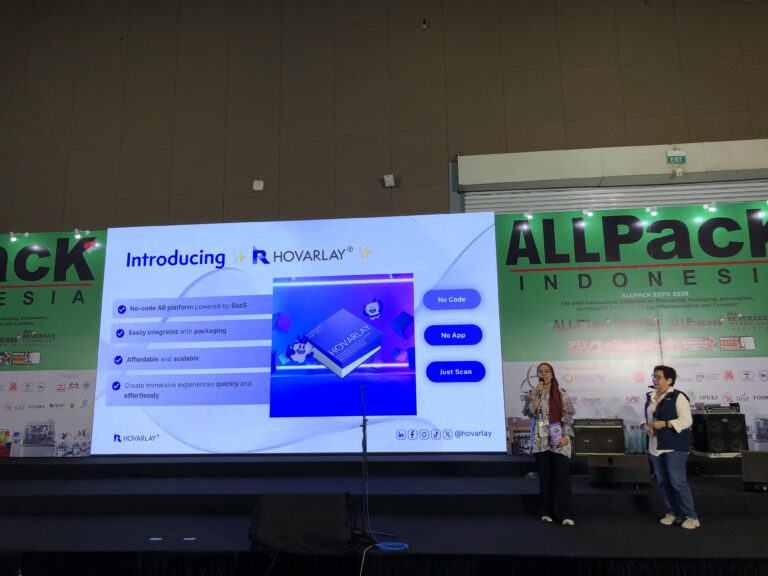
On the demand side, the Indonesian Packaging Federation (IPF) and other regional industry bodies are increasingly engaging with AR-enabled packaging as part of the broader smart packaging conversation. ALLPack Indonesia 2025 and IRSE 2025 both featured AR-enabled smart packaging as part of category programming. Singapore Print Media Association coverage of AR-enabled packaging brands has been increasing year-on-year.
Country-by-country Signals
The regional category is not uniform. Country-level conditions vary.
Singapore
Singapore is the regional AR packaging hub by deployment density. The market is small but mature, with high penetration of premium and gifting CPG categories where AR delivers strong return. Singapore’s GMV reached USD 29 billion in 2025 per e-Conomy SEA. Singapore secured USD 1.31 billion in private AI funding in H1 2025, indicating the broader digital innovation appetite. Brand-led deployments dominate; large CPG players use Singapore as the regional pilot market.
Indonesia
Indonesia is the regional volume market. Population scale, smartphone-first consumption, and a youthful demographic combine to make Indonesia the largest single-country opportunity for AR packaging in SEA. The growth concentrations are food and snacks, oral care, and cultural-festive packaging. Local heritage brands, MSMEs, and major CPG portfolios are all running AR-enabled activations. The IWAPI Digital and HOVARLAY partnership announced in 2025 specifically targets MSME enablement on smart AR packaging.
Malaysia, Thailand, Vietnam, Philippines
These four markets show parallel growth signals but at lower current deployment density. Malaysia and Thailand have above-average premium CPG penetration. Vietnam and the Philippines show high mobile-first engagement metrics that favour WebAR adoption. The 2025 e-Conomy SEA report cites Indonesia, Malaysia, and Vietnam as recording double-digit growth in tourist arrivals, which supports gifting and travel-retail AR opportunities.
Brunei, Cambodia, Laos, Myanmar
These markets were added to e-Conomy SEA coverage for the first time in 2025, with combined GMV of USD 6 billion in 2025 projected to USD 10 billion by 2030. AR packaging deployment in these markets is at an early stage. Cross-border campaigns from Indonesian or Singaporean brand owners are the more likely vector than locally-originated AR packaging in the near term.
What the Next 18 Months Will Look Like
Three trajectories will define SEA AR packaging through 2027.
The 8th Wall migration window will accelerate platform consolidation. Brands that built AR experiences on 8th Wall through 2024 and 2025 are now choosing migration platforms. The platforms that win the migration build commercial weight for the next campaign cycle.
First-party data capture will become the primary AR packaging KPI. The retreat from third-party cookies and the regulatory tightening around personal data in Indonesia, Malaysia, and Singapore is pushing CPG marketers to invest in consented first-party data channels. AR-triggered packaging is one of the cleanest consent-based capture mechanisms available, and Uniqode’s 2026 finding that over 80 percent of consumers are willing to share data through QR-triggered experiences supports the case.
Gamification will become the default mechanic. Appetite Creative’s 2026 survey finding that two-thirds of brands are already using game mechanics on QR packaging is the leading edge of what will become category standard by 2027. Brands not gamifying will sit at a measurable engagement disadvantage to the brands that do.
The category is no longer in the innovation phase in Southeast Asia. It is in the rollout phase. The CPG packaging that ships in this region in 2027 will mostly include a digital trigger by default. The competitive question is what experience sits behind the trigger.
Frequently Asked Questions
Q: Is Indonesia or Singapore the better SEA pilot market for AR packaging?
Singapore for premium and gifting categories with smaller volume but mature digital infrastructure. Indonesia for mass-market food, snacks, and oral care with larger volume but more diverse consumer segments. The right pilot market depends on the SKU portfolio and the brand objective, not on a single regional ranking.
Q: How does SEA AR packaging compare to North America or Europe in deployment maturity?
North America retains larger total market value, with 39.74 percent global smart packaging revenue share in 2025 per Mordor Intelligence. APAC is growing faster at 9.76 percent CAGR. Within APAC, SEA shows above-average growth signals driven by QR fluency, mobile-first consumption, and cultural campaign concentration.
Q: Does the regional smart packaging market sizing include AR packaging?
Yes, AR packaging is a sub-segment of the broader smart packaging market in most industry reports. Mordor Intelligence’s USD 25.84 billion 2026 smart packaging market sizing captures sensor-based, RFID, NFC, and AR-enabled packaging across the smart packaging definition. Grand View Research’s AR-specific USD 354.9 million 2024 sizing is the narrower AR-only segment.
Q: How should regional CPG marketers think about budgeting for AR packaging in 2026?
Budget AR packaging as an extension of shopper marketing and brand activation, not as an experimental digital line. The unit cost of digital triggers on packaging is negligible compared to the print run itself. The variable cost is the experience design, which can be amortised across multiple SKUs and campaigns through reusable platform investment.
Q: Are there regional regulations to be aware of for AR-enabled packaging?
Standard packaging labelling and consumer protection rules apply. Data capture through AR experiences should comply with the regional data protection regimes: Singapore PDPA, Indonesia PDP Law, Malaysia PDPA, and equivalent frameworks in other ASEAN markets. The data capture itself is no different in regulatory terms from any other digital channel, which means the standard consent and disclosure protocols apply.
About the author
Kimming Yap is the Co-Founder of HOVARLAY, an experience technology company building AR-enabled packaging and interactive consumer experiences for CPG brands across Southeast Asia.