On this page
AR Packaging for Beauty and Wellness: From Ingredients to Experience
- Why Beauty Is One of the Best Categories for AR Packaging
- Ingredient Transparency: The Fastest-Growing Beauty AR Use Case
- Virtual Try-On: Removing the Biggest Beauty Purchase Barrier
- Tutorial and Application Content: Extending the Brand Relationship
- Sustainability Storytelling for Beauty Brands
- Gamified Beauty Campaigns: Driving Trials and Loyalty
- Frequently Asked Questions
- What types of AR experiences work best for beauty packaging?
- Do users need a special app to access AR beauty experiences on packaging?
- How does AR ingredient transparency work in practice?
- Can small beauty brands afford AR packaging?
- How do beauty brands measure the effectiveness of AR packaging?


- Beauty and wellness is one of the highest-value categories for AR packaging: ingredient transparency, try-on, tutorial content, and sustainability storytelling all have strong user demand.
- WebAR beauty activations remove the largest purchase barrier in the category: uncertainty about how a product will look or perform before buying.
- Ingredient transparency via AR is becoming a baseline expectation among health-conscious beauty users, not a premium feature.
- AR packaging for beauty extends the shelf conversation beyond what any label can hold: full ingredient sourcing, dermatologist commentary, application tutorials, and sustainability data.
- HOVARLAY’s no-code platform makes it possible to build and launch beauty AR experiences without an agency, a developer team, or a large budget.
Why Beauty Is One of the Best Categories for AR Packaging
Beauty and wellness packaging has more to communicate than almost any other CPG category, and less label space to do it in. AR removes that constraint entirely.
A typical skincare product needs to communicate active ingredients and their concentrations, the dermatological rationale for the formulation, usage instructions across different skin types, full ingredient list with INCI names, sourcing and sustainability credentials, brand story and positioning, and promotional campaign messaging. None of this fits on a label that also needs to meet regulatory requirements across multiple markets.
The purchase decision in beauty is also uniquely information-dependent. A user buying a moisturiser wants to know whether the formula suits their skin type, whether active ingredients are at effective concentrations, and whether the brand’s sustainability claims hold up. In a physical retail environment, most of this information is unavailable at the point of purchase.
AR packaging addresses both problems simultaneously. It gives the brand unlimited space to tell the product story, and it gives the user the information they need to buy with confidence.
Ingredient Transparency: The Fastest-Growing Beauty AR Use Case
Health-conscious beauty users in 2026 expect to understand what is in their products, why each ingredient is there, and where it came from. AR packaging is the only format that can deliver this at scale without a reprint.
The clean beauty movement has fundamentally changed user expectations around ingredient transparency in Southeast Asia and globally. Users are reading labels, searching ingredients, and downloading apps to decode formulations. They want to know whether a preservative is necessary, whether a fragrance ingredient is synthetic or natural, and whether any component conflicts with their values.
A standard label can list INCI names. It cannot explain them. AR packaging can. Scanning the pack launches an experience where every ingredient is listed with a plain-language explanation: what it does, why it is in the formula, what the sourcing standard is, and what third-party certifications apply. For brands that have invested in clean formulations, this transparency converts a label claim into verifiable proof.
The commercial impact is measurable. Users who understand why an ingredient is in a formula are more confident in their purchase. Users who can verify a sustainability claim rather than simply reading it are more likely to become loyal customers. AR ingredient transparency is not just a brand values statement: it is a conversion tool.
Virtual Try-On: Removing the Biggest Beauty Purchase Barrier
Virtual try-on via AR removes the single largest friction point in beauty retail: the inability to test a product before purchasing.
In a physical beauty counter, a trained consultant can demonstrate shades, help a user find their match, and provide application guidance. In a pharmacy, supermarket, or online channel, that service does not exist. The user is choosing based on a small swatch on the label and whatever they can find online. Return rates in beauty are high for exactly this reason.
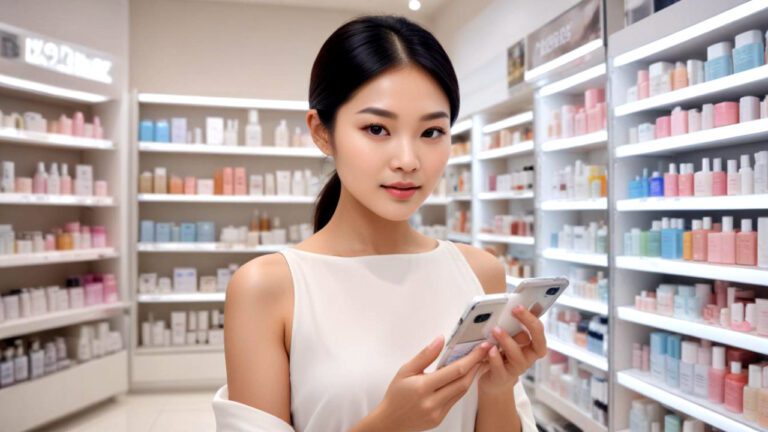
AR try-on addresses this directly. When a user scans a foundation, lipstick, eyeshadow, or blush pack, the AR experience opens their camera and overlays the shade on their face in real time. They can see, with reasonable accuracy, how the product will look on their skin tone before purchasing. Brands including L’Oreal have documented meaningfully higher conversion rates on product pages with AR try-on compared to equivalent pages without it.
For beauty brands without the technology budget of a global player, HOVARLAY provides the WebAR infrastructure. The try-on experience can be added to existing packaging via a QR code without any changes to the physical label.
Tutorial and Application Content: Extending the Brand Relationship
AR packaging is the only channel that can deliver full-length tutorial content at the point of purchase, linking the product directly to the expertise that drives repeat use and brand loyalty.
A first-time buyer of a serum with a multi-step application protocol needs guidance that the label cannot provide. A user buying a contouring palette for the first time needs a tutorial that a two-sentence instruction cannot deliver. In both cases, the gap between purchase and successful use is a loyalty risk: users who cannot figure out how to use a product correctly are less likely to repurchase.
AR packaging closes that gap. Scanning the pack launches the tutorial directly: step-by-step application guidance, before and after visual references, tips from the brand’s aesthetician or dermatologist, and links to the full product range for complementary recommendations. The user gets what they need to succeed with the product, in the moment they need it.
This also creates a natural upsell moment. Tutorial content that demonstrates a serum working best when layered with a specific moisturiser creates a purchase-stage cross-sell opportunity that no other packaging format can deliver.
Sustainability Storytelling for Beauty Brands
Beauty users are among the most sustainability-conscious across all CPG categories, and AR packaging is the most credible way to tell a sustainability story that goes beyond label claims.
Clean formulations, sustainable sourcing, recyclable or refillable packaging, cruelty-free and vegan certifications, carbon-neutral production. These are purchase drivers for a significant and growing segment of beauty users in Singapore, Indonesia, and globally. They are also claims increasingly subject to regulatory scrutiny under green claims legislation.
AR packaging can transform sustainability claims into sustainability proof. Scanning the pack can open a supply chain transparency experience: the ingredient sourcing map, the certification documents, the packaging recyclability guide specific to the user’s location, the brand’s net-zero progress tracker. Each claim is backed by verifiable data, delivered at the point of purchase. Because the AR experience is cloud-hosted, it can be updated when certifications change or new sustainability milestones are reached.
Gamified Beauty Campaigns: Driving Trials and Loyalty
Gamified AR packaging mechanics are highly effective in the beauty category for driving product trials, loyalty registration, and social sharing.
The beauty category has a natural affinity with play and personalisation. Skin type quizzes, shade matching tools, “find your formula” interactive experiences, and virtual makeover challenges all translate well into AR packaging mechanics. These experiences create engagement beyond the single purchase moment and give users a reason to return to the brand.
For new product launches, gamified AR packaging can build awareness before the product reaches mass distribution. For established products, loyalty registration mechanics embedded in AR experiences build the CRM database that supports ongoing relationship marketing. HOVARLAY’s Campaigns module handles all of these mechanics without code. View pricing
Frequently Asked Questions
What types of AR experiences work best for beauty packaging?
Virtual try-on is the highest-value mechanic for colour cosmetics. Ingredient transparency experiences work best for skincare brands with clean or science-backed formulations. Tutorial content is most effective for complex or multi-step products. Gamified campaigns work across all beauty subcategories for lead generation and loyalty building.
Do users need a special app to access AR beauty experiences on packaging?
No. HOVARLAY uses WebAR, which runs in the mobile browser. Users scan a QR code with their standard camera app and the experience launches immediately. No dedicated AR app, no beauty brand app, and no download is required.
How does AR ingredient transparency work in practice?
The brand builds an ingredient breakdown experience in the HOVARLAY Creator. Each ingredient is listed with a plain-language explanation, sourcing information, and relevant certifications. When users scan the pack, they can tap any ingredient for more detail. The experience is hosted in the cloud and can be updated when formulations change, with no reprint required.
Can small beauty brands afford AR packaging?
Yes. HOVARLAY’s Starter plan begins at $6-9 per SKU per month. A small beauty brand with three or four SKUs can run connected packaging across its full range for less than the cost of a single social media campaign.
How do beauty brands measure the effectiveness of AR packaging?
HOVARLAY Insights tracks scan rate, engagement time, interaction events, and conversion rate in real time. For try-on experiences, brands can track which shades were virtually tested most frequently. For ingredient transparency, they can see which ingredients users click on most.
Build your beauty AR packaging experience. No developer required. Start free on HOVARLAY