On this page
How to Plan an AR Packaging Campaign: A Step-by-Step Guide
- TL;DR
- How to Plan an AR Packaging Campaign
- Step 1: Define the Campaign Goal Before You Touch the Creative
- Step 2: Choose the Right Trigger Mechanism
- Step 3: Build the AR Experience With HOVARLAY Creator
- Step 4: Configure the Campaign Parameters
- Step 5: Measure, Learn, and Prepare the Next Iteration
- Frequently Asked Questions


TL;DR
- An AR packaging campaign turns a product label or box into a scannable, interactive experience without requiring any app download.
- Planning one takes five clear steps: define the goal, choose the trigger, build the experience, configure the campaign, and measure results.
- The biggest mistake brands make is skipping the goal definition and jumping straight to the visual — that leads to an experience nobody knows how to evaluate.
- HOVARLAY’s Campaigns module handles lead capture and gamification natively, so brands do not need to stitch together separate tools.
- HOVARLAY internal data shows campaigns built on the platform average a 13.23% conversion rate, which makes AR packaging one of the highest-performing physical touchpoints in CPG marketing today.
How to Plan an AR Packaging Campaign
Most marketing teams know what AR packaging is. Fewer know how to run a campaign around it — and that gap is where most pilots stall. This guide walks through the practical steps to plan an AR packaging campaign from brief to launch, with no developer required and no ambiguity about what success looks like.
The global AR market reached USD 120.21 billion in 2025, with Asia Pacific identified as the fastest-growing region (Grand View Research, 2025). For CPG brands in Southeast Asia, the timing to pilot AR on packaging has never been better. But scale is only valuable if individual campaigns are built on a clear structure. That structure is what this guide delivers.
Step 1: Define the Campaign Goal Before You Touch the Creative
The goal determines everything else. Before choosing an animation style or writing a QR code brief, a brand team needs to answer one question: what should a user do after they scan the packaging?
There are three main goal types for an AR packaging campaign. The first is engagement: the user scans, experiences something delightful — a 3D product story, an animation, a recipe reveal — and walks away with a stronger memory of the brand. This works well for brand awareness plays and new product launches. The second is lead generation: the user scans and enters a game, a spin wheel, or a form that captures their contact details. HOVARLAY’s Campaigns module is built specifically for this. The third is conversion: the user scans and is routed to a purchase page, a loyalty programme, or a limited-time offer. The experience is shorter and the CTA is direct.
Each goal type changes the design of the experience, the metrics you track, and the way you brief the creative. A lead-generation campaign needs a prize mechanic and a privacy-compliant form. An engagement campaign needs a 10 to 20 second experience that rewards attention without demanding it. Getting the goal wrong at this stage means the entire downstream campaign will optimise for the wrong thing.
Document the goal in a single sentence before the project moves forward. “Users who scan the pack will enter their email for a chance to win X” is a complete brief. “We want to do something cool with AR” is not.
Step 2: Choose the Right Trigger Mechanism
The trigger is what activates the AR experience. For packaging campaigns, there are two practical choices: a QR code and a WebAR image tracker.
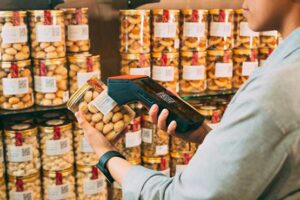
A QR code is the fastest route to launch. It is printable, universally scannable, and requires no SDK. Users open their camera app, point it at the code, and the experience loads in the browser. There is no app to download. For brands running their first AR packaging campaign, a QR code trigger is the recommended starting point. It removes the biggest barrier to user action — the friction of downloading something.
An image tracker uses the product label itself as the trigger. When a user points their phone at the branded artwork, the AR experience launches. This creates a cleaner brand experience because the packaging becomes the interface. It works best on products with distinctive, high-contrast label artwork and where users are likely to discover the feature organically, rather than being directed to it by a QR prompt. Shopify notes that AR experiences tied to physical products significantly increase the likelihood that a user will engage with that product online after seeing it in person (Shopify, 2023).
Whichever trigger you choose, test it on the actual printed packaging — not just a digital mock-up. Print resolution, varnish, and lighting conditions in a retail aisle all affect scan performance. A trigger that works perfectly on screen can fail in a real store environment if this step is skipped.
Step 3: Build the AR Experience With HOVARLAY Creator
Once the goal and trigger are locked, the experience itself can be built. HOVARLAY’s no-code WebAR builder lets brand teams create AR packaging experiences without writing a single line of code. Visit hovarlay.com/webar-builder/ to see what the builder handles: 3D model placement, video overlays, animated scenes, and gamified campaign mechanics can all be configured through a drag-and-drop interface.
The experience should match the campaign goal defined in Step 1. For a lead-generation campaign, the HOVARLAY Campaigns module provides built-in spin wheels, scratch cards, and prize draw mechanics that connect directly to a lead capture form. For an engagement campaign, a short looping animation tied to the product story — ingredients in a beverage, the manufacturing process of a food product, a seasonal theme for a festival SKU — is enough to create a memorable moment.
Keep the experience between 10 and 25 seconds for first-time scans. Anything longer risks losing the user before they complete the action you want. If the experience is compelling, users will return and explore further on repeat scans. Start short, prove the concept, then expand in the next iteration.
HOVARLAY’s real-world deployments demonstrate what this looks like in practice. During the HERA Bathroom Chinese New Year campaign, a WebAR activation on red packet packaging drove interactive engagement at a gifting event. The Happy Harvest 10.10 campaign used gamified AR experiences to drive lead capture during a high-traffic sales moment. These cases are documented at hovarlay.com/case-studies/.
Step 4: Configure the Campaign Parameters
The experience is only one part of the campaign. The second part is how the campaign is structured around that experience, including its duration, entry rules, prize mechanics, and data collection.
In HOVARLAY’s Campaigns module, brands configure start and end dates, spin limits per user, prize tiers, and lead form fields. These parameters determine how the campaign behaves at scale. A campaign with no spin limit per user can be gamed. A campaign with an overly long form loses leads at the input stage. A campaign with a prize that ships internationally but no geo-restriction creates fulfilment problems.
Set the campaign window to match the product’s distribution cycle. A seasonal SKU that sits on shelf for six weeks should have a campaign that runs for six weeks — not indefinitely. Use HOVARLAY’s Insights module to monitor real-time scan volume, entry rates, and conversion so you can adjust messaging and placement if early results are below target.
Pricing for a campaign-enabled SKU starts from the Starter tier at hovarlay.com/pricing/. Brands running a pilot on one SKU can validate the model before committing to a full portfolio rollout.
Step 5: Measure, Learn, and Prepare the Next Iteration
An AR packaging campaign does not end at launch. The data it generates is the most valuable output, because it tells you which packaging, which placement, and which mechanic drove the most action.
The metrics that matter depend on your goal. For engagement campaigns, track unique scan count, session duration, and return scan rate. For lead-generation campaigns, track entry count, form completion rate, cost per lead, and the quality of leads captured (verified email, opted-in, contactable). HOVARLAY’s Insights module surfaces all of these in a single dashboard. HOVARLAY internal data shows campaigns built on the platform average a 13.23% conversion rate from scan to lead entry (HOVARLAY internal data, 2025).
Compare results across SKUs, retail channels, and geographic markets if you have multi-region distribution. A campaign that performs well in a supermarket may perform differently at a convenience store or a specialty retailer. The data makes these differences visible, which turns the next campaign brief into a smarter document than the first one.
After the campaign ends, archive the experience and the results in a format your team can reference. The brands that build institutional knowledge from their first AR packaging campaign will run their second one faster and better. The brands that treat each campaign as a standalone activation restart from zero every time.
Start free at https://dashboard.hovarlay.com/signup to test your first AR packaging campaign on one SKU. No developer required, no long-term commitment.
Frequently Asked Questions
Q: What is an AR packaging campaign?
An AR packaging campaign is a marketing activation that uses augmented reality to make a product’s packaging interactive. Users scan a QR code or point their phone at the label, and an AR experience loads directly in their browser without any app download. The experience can include animations, games, product information, or a lead capture mechanic.
Q: How long does it take to launch an AR packaging campaign?
With a no-code platform like HOVARLAY Creator, a straightforward AR packaging campaign can be built and configured in a few days once the creative brief and assets are ready. The timeline depends on the complexity of the 3D or animated experience, the campaign mechanics selected, and the time needed for QR code or image tracker testing on printed packaging.
Q: What makes a good AR packaging campaign goal?
A good goal is specific, measurable, and tied to a single user action: scan and enter details, scan and watch, or scan and buy. Goals that try to achieve all three at once usually result in a confused experience. Pick the most important outcome for this SKU and this campaign window, then measure only that.
Q: How do I know if my AR packaging campaign worked?
Track the metrics that match your goal. For engagement campaigns: scan count, session duration, and return rate. For lead-generation campaigns: entry rate, cost per lead, and lead quality. HOVARLAY’s Insights module provides real-time data on all of these without any manual export.
Q: Can I run an AR packaging campaign on just one product SKU?
Yes. Most brands start with a single SKU to validate the model before rolling out across a portfolio. HOVARLAY’s per-SKU pricing is designed for exactly this approach. A pilot on one product generates real scan data, real lead data, and a clear read on whether the mechanic fits the brand’s audience, all at a contained cost.
Related reading: AR Packaging Examples: 10 Brands Getting It Right in 2026 | AR QR Code Packaging: Turn Labels Into Experiences